

Last week, I sat in on a QBR for a client in Dubai Media City.
The mood was self-congratulatory. The Head of Digital threw up a slide with a massive green number: 92% AI Adoption.
“As you can see,” he said, “the team has fully embraced the new Enterprise licenses. We are disrupting the workflow.”
The CEO didn’t smile. He leaned forward, looked past the executive, and pointed to a Junior Marketing Manager in the back row.
“Ahmed,” the CEO said. “You’re part of that 92%. Tell me one specific business outcome you ‘disrupted’ this week using the new tool.”
The room went silent. You could hear the AC humming.
Ahmed shifted in his chair, looked at his feet, and stammered, “Well… I used it to polish the today’s QBR invite.”
The air left the room.
Here was a company spending tens of thousands of Dirhams on advanced infrastructure. And they are hitting a strategic KPI to “Be Disruptive.”
Yet, in practice, are were using the most powerful tool in human history as a spell-checker.
This isn’t Ahmed’s fault. It’s a leadership failure.
Most companies I walk into are suffering from this exact delusion. They confuse access with application.
They believe that if they buy the tools, the “disruption” will naturally follow.
But the data tells a different story.
Ahmed’s lunch invite isn’t an anomaly. It is a symptom of vague goals.
The Smart Tool Paradox
Most leadership teams treat AI as a plug-and-play software update. They think if they get the math right, the business will follow.
But math is the smallest part of the equation.
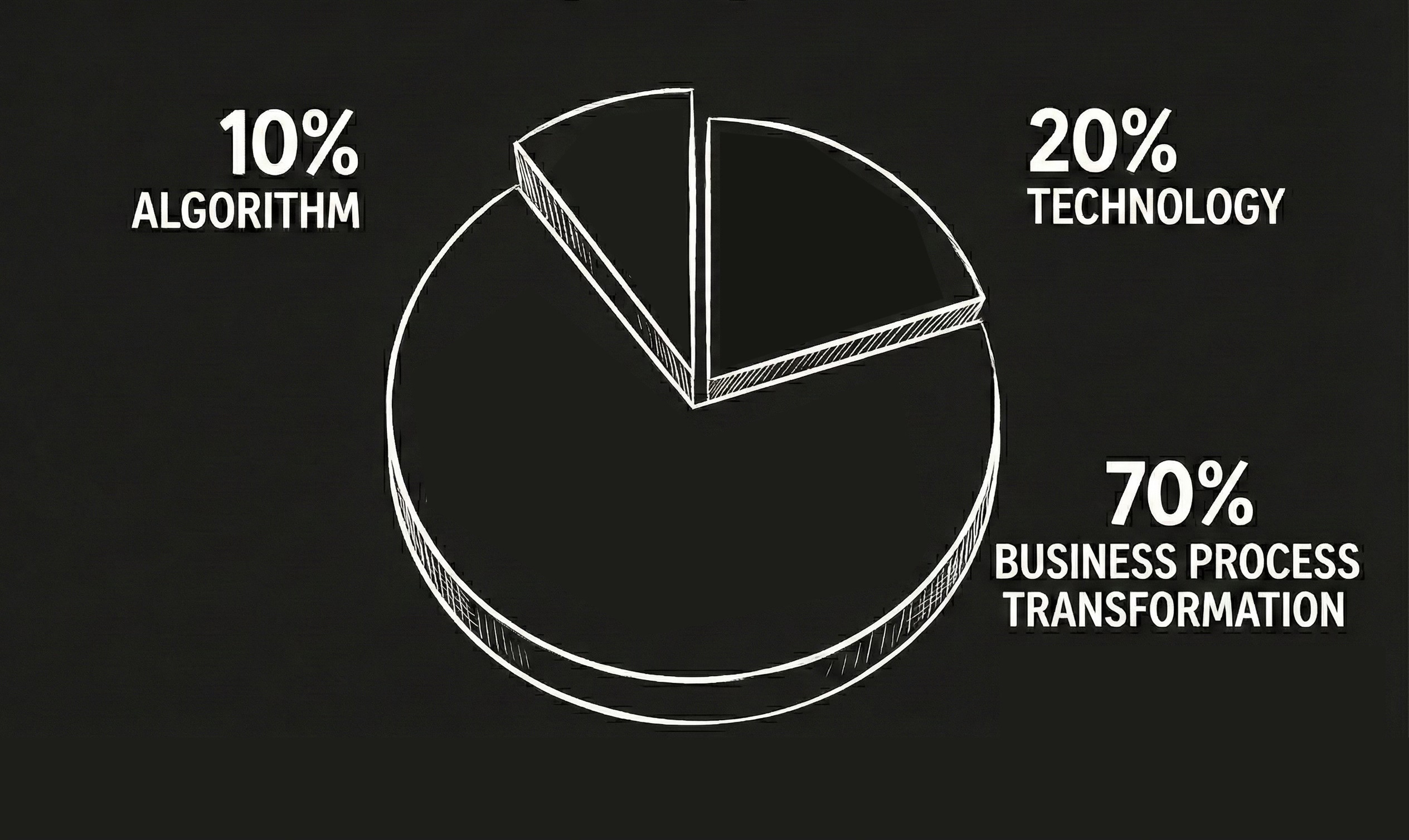
To actually disrupt your market, you need to understand The 10/20/70 Rule (BCG):
10% is the Algorithm: The LLM itself (GPT-4, Claude, Gemini).
20% is the Technology: The infrastructure, data pipelines, and IT integration.
70% is Business Process Transformation: The people, the workflows, and the change management.
The CEO in my story spent 100% of his budget on the first 30%. He ignored the 70%.
If your “Disruption” strategy is just buying ChatGPT Enterprise, you haven’t bought disruption. You have bought a gym membership for a team that doesn’t know how to lift weights.
The “Arsonist” Approach to Disruption
When the C-Suite yells “Disruption!”, the workforce often hears “Layoffs.”
And they aren’t entirely wrong.
“Disruption” is synonymous with “cost-cutting via headcount” today.
We saw this in 2025, where firms cut over 130,000 tech workers citing AI restructuring as the cause.
But this is “Arsonist” leadership, not architectural leadership.
If you fire people faster than you can automate their roles, you create a “Persistence Gap.”
You burn down institutional knowledge.
Destroy culture.
And erode trust before the AI is capable of filling the void.
Real AI leaders don’t use tech to replace humans.
They use it to “augment” capacity. Giving a junior employee the output of a senior manager, rather than firing the junior employee to save a salary.
The “Be Disruptive” KPI Trap
“Be Disruptive” is the most ambigious KPI on a balanced scorecard.
It is entirely subjective.
I see Department Heads chasing shiny objects all the time.
Hackathons, pilot programs, cool image generators.
All this just to prove they are “being disruptive” during their quarterly review.
This is activity, not achievement.
We need a metric makeover.
You cannot manage what you cannot measure, and you cannot measure “vibes.”
Serious AI leaders don’t use vague words like “Disruption”.
They look for objective wins.
Reducing legal contract review time by 60%.
Increasing customer support ticket resolution by 30%,.
Automating supply chain forecasting.
If you can’t put a number on it, it’s not a strategy; it’s a science project.
The Safety Net Problem
There is a belief in the startup world that “guardrails kill speed.”
Corporate leaders often think that to be disruptive, they need to remove all red tape.
The opposite is true. In a corporate environment, guardrails create speed.
Without clear ethical and data boundaries, your employees will be paralyzed by fear.
They’ll never use the tools out of fear.
What if they accidentally leak data?
What if they make something thats super non-compliant?
What if they produce something may get them sued?
A 2024 Adecco report stressed that a clear ethical framework is a prerequisite for success. When you define the “Safety Lanes”, you give your team the psychological safety to run fast.
How to Fix the “People” Part
If 70% of success is people and process, that is where 70% of your energy needs to go.
Most leaders delegate this to HR or IT and forget about it. That is a mistake. As a leader, you must manage the “human integration” of these tools.

Here is the 3-step framework I use with my corporate clients to close the gap.
Step 1: The Process Audit
The single biggest mistake companies make is layering AI on top of broken workflows.
As Gates said “automation applied to an inefficient operation will magnify the inefficiency.”
If your reporting process is bureaucratic, confusing, and slow.
If you keep producing long PDFs that nobody reads.
And you use AI to generate that report in 5 seconds instead of 5 hours, you haven’t created value. You have simply automated waste.
Before you hand out licenses, you must perform a “Workflow Dissection.”
How to do it:
Isolate the Task: Pick one high-volume activity (e.g., Monthly Client Reporting).
Map the Steps: Write down every human touchpoint required to finish that task.
Identify the “Bloat”: Circle the steps that exist only because of legacy systems or “we’ve always done it this way.”
Simplify First, Automate Second: Delete the bloat. optimize the human process first. Only once the process is lean do you inject the AI.
The Golden Rule: Never use AI to speed up a process you wouldn’t be proud to show your board of directors manually.
Step 2: The Mindset Shift
The reason Ahmed (from our story) didn’t use the tool effectively wasn’t laziness. It was likely fear.
When employees hear “AI Efficiency,” they subconsciously translate it to “Job Redundancy.” This triggers self-preservation.
They will either hide how they work, or they will perform “weaponized incompetence”. They’ll pretend that the tool doesn’t work so they can keep doing things the old way.
You need to change the narrative in your town halls. Stop talking about “Disruption.” Start talking about “The Boredom Audit.”
The Action Plan:
Ask your team to list the tasks they hate. The data entry. The meeting summarization. The formatting of slides. The sorting of Excel rows.
Then, frame AI as the “Boredom Killer.”
Tell them: “My goal is not to automate YOU. My goal is to automate the parts of your job that you despise, so you can spend more time on strategy and creativity.”
When you position AI as a tool that gives them their time back (rather than a tool that takes their paycheck away) then they’ll see AI as tool and not enemy.
Step 3: Establish Guardrails, Not Gates
Traditional IT departments operate on a “Gate” model.
Can I use this tool? No.
Can I upload this PDF? Submit a ticket.
Can I try this prompt? Wait for approval.
Gates kill speed. In the age of AI, if you move slowly, you are already dead. But if you move fast without safety, you risk a PR disaster or a data leak.
The solution is “Guardrails.”
Think of a highway.
You don’t put a gate every 100 meters to check if drivers are safe.
You put guardrails on the side so they can drive at 120 km/h without flying off the cliff.
The Traffic Light Protocol:
Implement a simple 3-tier data policy for your team:
🟢 Green Lane (Public Data):
Anything already on your website, marketing materials, or public domain.
Rule: Use freely with any approved AI tool.
🟡 Yellow Lane (Internal Work):
Internal memos, drafts, brainstorming.
Rule: Use only with Enterprise accounts (data privacy mode on).
🔴 Red Lane (Toxic Data):
PII (Personal Identifiable Information), Salary data, Client financial records.
Rule: NEVER upload to an LLM.
Once this protocol is clear, step back.
Give your team the autonomy to run fast in the Green and Yellow lanes.
What Now?
If you’re really down to harnessing AI and taking the driving seat of your future. Here are the things you’ll need.
1. Access to rich AI education.
Which, unfortunately, is extremely rare. Most of the internet is filled more with AI sensationalism than any deep education.
You can subscribe to this newsletter for such in-depth AI education for free.
If you are a leader of some enterprise, I recommend you join our exclusive WhatsApp channel that I have. (only qualified participants are allowed).
2. Roadmap and Guidance
There are many roadmaps to becoming an expert in AI.
95% of them are for data scientists and programmers.
4.9% for freelancers and entrepreneurs.
Hardly any are for corporate professionals.
3. Real 1:1 Training
If you’re a L&D Manager, HR Director, CHRO or a CEO, hire me to train or inspire your employees.
Thank you for reading this letter.
See you in the boardroom.